General Info
The purpose of this learning scenario is to discover and propose a variety of hardy plants (plants that can survive adverse growing conditions) that acts as a nature-based solution (NBS) to green cities, urban heat and oxygen production as well as citizens' well being. These plants can be planted to various spots of the city to make the city sustainable. Although this learning scenario uses a suburb of Athens as an example, it can be implemented using other cities and areas as a basis. Students are going to visit a green area (in this case: Nea Filadelfeia Park of Athens) to search and take photographs of various plants. The plants in the park are adapted to the city microclimate but the students have to seek for those with less maintenance needs. These photographs are going to be imported in Pl@ntNet, a citizen science project for automatic plant identification through photographs based on machine learning, so as to discover which of the plants are hardy according to Greece hardiness zone map (a map with geographic areas defined to encompass a certain range of climatic conditions relevant to plant growth and survival). A Padlet with the hardy plants, that students have detected, is created and is communicated to the local municipality along with posters made with drawings of the most significant hardy plants. QR codes are glued to the poster to embed other information. The posters will decorate classrooms and school for dissemination.
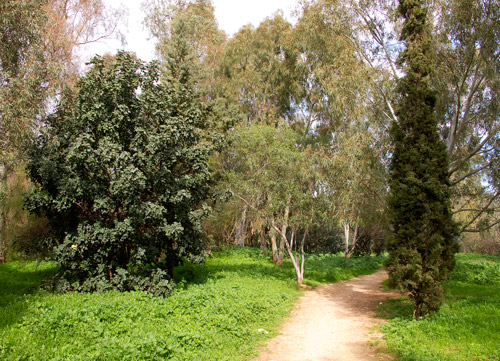
Nea Filadelfeia Park covers 480 hectares and features a wide variety of flora. https://athensattica.com/things-to-do/parks/nea-philadelpheia-park/
Audience and Educational Framework
Educational Details
At the beginning of the practice, the teacher introduces students to the key terms of Nature Based Solutions, hardy plants and hardiness zones. After a brainstorming discussion, the students conclude that creating green spots with hardy plants, using cost-effective and supported by nature solutions, is a necessity. The investigation of a green space in their city comes next and students take photographs of various plants. Implementing the flipped classroom model, the students investigate places in their neighborhood which can be turned into green areas and add the places to a Google Map as a homework.
In the ICT lab, students in groups (collaborative learning) use Pl@ntNet machine learning model to identify the name and hardiness of their plants. Then, they create a Padlet with the photographs of the plants that can survive adverse growing conditions which is communicated along with their google map to their local municipality's green sector.
To relate the project to Arts, the students create a poster on cardboard with drawings of the most significant hardy plants and glue QR codes next to their paintings to embed more information. These posters decorate the school and the classrooms with a view to disseminating the students' project.
At the end of the lesson students will be able to:
- Understand what Nature-Based Solutions are
- Understand the relationship between green spaces and the city’s well being
- Implement Nature Based Solutions in their closest surroundings (their city)
- Understand what hardy plants and hardiness zones are
- Analyze, plan and share the implementation of a practical case
- Use computers, smartphones and mobile devices consciously
21st century skills:
1.Learning skills:
- Critical Thinking: Students develop their critical thinking, innovation and creativity trying to implement NBS in their surroundings
- Problem solving: Students define problems, develop problem solving, decision-making and deliver a solution.
2.Technology skills:
- Information literacy: Students receive relevant information about NBS and hardy plants.
- ICT literacy: Students get acquainted with new technologies (smartphones, tablets), web 2.0 tools (Padlet, Kahoot, Wakelet, Google docs and maps) and machine learning (Pl@ntNet)
- Ability to use and create content for technology, to find and share information
3.Life skills:
- Students develop positive attitudes, take initiatives, learn how to interact with one another and value each other's opinions.
- Students plan and manage time for doing all activities effectively, participate actively and collaborate effectively.
- Students develop personal and social responsibility
- Social and cultural awareness: ability to interact with other people in a socially and ethically appropriate way (communicate their outcome to municipality)
Hardware: PCs, projector, Internet connection
Other resources:
- Nature for cities: https://www.nature4cities.eu/
- Nea Filadelfeia Park: https://athensattica.com/things-to-do/parks/nea-philadelpheia-park/
- Oppla case studies: https://oppla.eu/case-study-finder
- NBS definition from European Commission: https://ec.europa.eu/info/research-and-innovation/research-area/environment/nature-based-solutions_en
- How to scan Qr codes using Google Lens: https://www.seniortechclub.com/nuggets/how-to-scan-a-qr-code-in-a-photo-using-google-lens/
- How to drop a pin on Google maps: https://youtu.be/InORWWNWAEg
- Pl@ntNet identifier: https://identify.plantnet.org/
- Europe Hardiness Zone Map: http://www.trumpetflowers.com/enlargements/europe-hardiness-zone-map.htm
- Greece plant hardiness Zone map: https://www.plantmaps.com/interactive-greece-plant-hardiness-zone-map-celsius.php
- Youtube (What is ecosystem-based adaptation;): https://www.youtube.com/watch?v=fhDuqvRk6LY&feature=emb_logo
- Youtube (ThinkNature Project on Nature-based Solutions): https://www.youtube.com/watch?v=6rn6jOZ6Bs8
- QR code maker: https://www.qrcode-monkey.com/
Implementation
(where and how the practice was implemented)
This educational practice has not been implemented yet. It can be implemented during remote teaching using synchronous and asynchronous tools too.
1. Definition and presentation of NBS and plant hardiness:
Lecture about NBS: Teacher uses the following material: NBS Definition from European Commission, Youtube (What is ecosystem-based adaptation;), Youtube (ThinkNature Project on Nature-based Solutions), Europe Hardiness Zone Map and Greece plant hardiness Zone map, to present the project's key terms to the students.
Brainstorming:
- Do we have enough green spots in our neighbourhood?
- Do we have in mind some spaces around us that we could use as small gardens?
- Where can we find a large sample of plants’ biodiversity to draw ideas for creating small green spaces around us?
- Who could help us, from our municipality, to the creation of little green spots?
This activity can also be implemented during remote teaching using synchronous and asynchronous tools.
2. Investigation of a green space in your city:
A visit to a green area (park) of students' city (in this case Nea Filadelfeia Park in Athens). Students search for plants, having in mind the size of the spaces they would like to turn in a green little garden, and take photographs of them using smartphones, tablets or cameras.
Alternatively, on schools’ closure due to Covid19 issues, students can visit the park individually with their parents to take the photos. If parks are closed, they can search images on the Internet for plants adapted to their country's climate or ask their parents and grandparents about different kinds of native plants.
3. Flipped Classroom activity:
The students are introduced to new topics outside of the classroom (how to scan their printed QR code, open a collaborative Google Map and drop pins on it). With their parents or grandparents, they will investigate the places in their neighbourhood which could be turned into green areas and learn how their neighbourhood used to be in the past. Then they add these places to the Google Map. Back to the classroom, they share their experiences in plenary and get support from the teacher if needed .
This activity can be implemented on schools’ closure. If we are facing a total lockdown, then some places, for example around our house or school, can be added by memory on the map.
4. Group definition:
The class is divided into groups of 4 students. Each group undertakes a number of photographs (5). Students upload their photos to their computer.
If this activity is to be implemented on remote teaching, the students work individually.
5. Using Pl@ntNet:
Each group uses the Pl@ntNet in order to identify the name and the hardiness of their plants [minimum temperature of -50 °F (−45 °C) to -40 °F (-40 °C) maximum temperature of 40 °F (4 °C) to 50 °F (10 °C)]
This activity can be implemented on remote teaching, but each student works individually at home.
6. Padlet creation:
Each group compares the hardiness of their plants to Greece’s hardiness zone and uploads to a common Padlet only the photographs of the plants that can survive adverse growing conditions.
This activity can be easily implemented on remote teaching, using the real-time collaborative Web2.0 tool Padlet.
7. Poster creation:
The students create a poster on cardboard with drawings of the most significant hardy plants. Then QR codes are created and glued to the poster with links to embed more information about these hardy plants. The poster is scanned and printed to decorate classrooms and school for the dissemination of this activity.
Remote teaching: Each student draws a hardy plant and creates its QR code at home and sends them to the teacher via email or mobile photo.
8. Communicating the Padlet:
The students write an email to their local municipality’s “Green sector”, describing their project and how the attached Padlet and Google Map can be used in order to make their city sustainable.
Remote teaching: The teacher uses a collaborative tool like Google Doc to allow the students to describe their project.
EVALUATION
During the entire project, the students will be assessed using formative as well as summative assessment. The formative assessment takes place in the form of a digital wall, through the learning products, or quizzes with the purpose of gathering information if all learning outcomes are achieved. At the end of the project, students and teachers complete questionnaires as feedback.
LESSONS LEARNED
At the end of this project, the students learn how to use technology to help them in solving real-life problems. They gain understanding of nature-based solutions and plants' hardiness. They develop critical thinking and computational skills through designing, inquiring and exploring, and improve their communications skills practising collaborative learning Simultaneously, the students realize the need of cost-effective and supported by nature solutions in order to benefit biodiversity and support the delivery of a range of ecosystem services.
Educational material/resources (file/URL) accompanying the practice
English
English
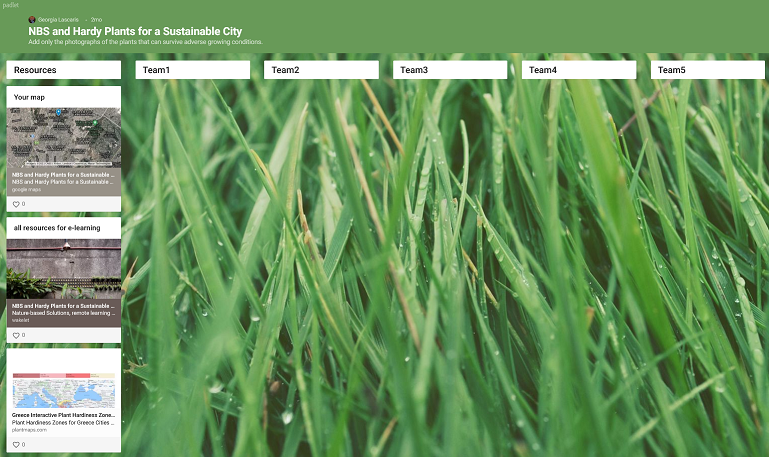
A Padlet with useful resources where students will "hang" only the photographs of the hardy plants they discovered in Pl@ntNet.
English
In this collaborative google doc, the students present their project by answering to the given questions.
English
A Wakelet with all the resources and step by step directions that the students may need in order to implement the activities.
English
A feedback questionnaire in a google form to assess students gaining knowledge after the end of the project.
English
A Kahoot online game as a students feedback on the implementation of the project and its activities.
A collaborative google map where students pin places of their neighborhood that can be turned to green spots.