

European Skills Agenda for sustainable competitiveness, social fairness and resilience
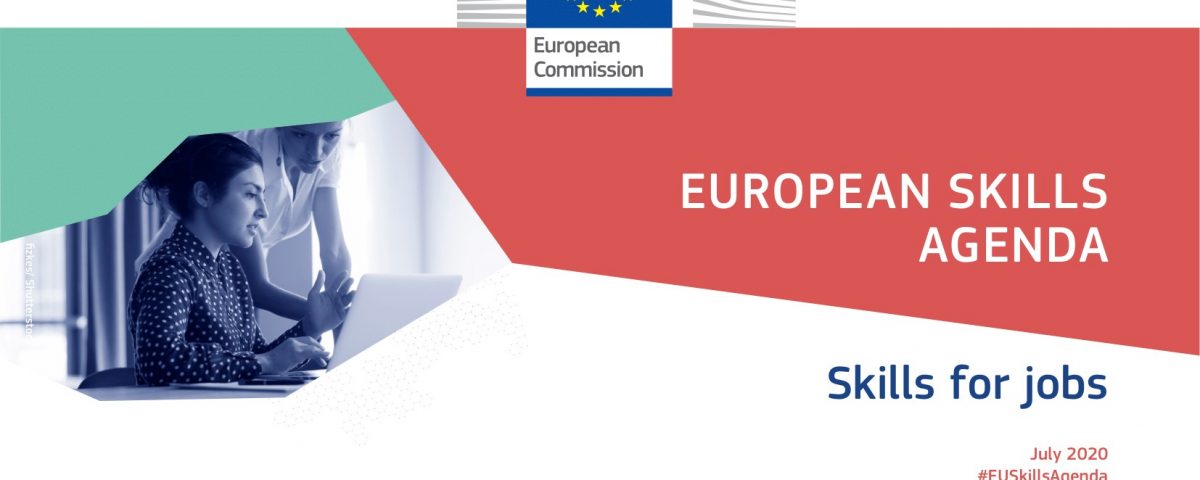
On 1 July 2020, the European Commission presented a new Skills Agenda setting ambitious objectives for upskilling and reskilling for the next five years.
The Agenda has 12 actions that focus on skills for jobs by partnering up with Member States, companies and social partners to work together for change, by empowering people to embark on lifelong learning, and by using the EU budget as a catalyst to unlock public and private investment in people’s skills.
The aim is to ensure that the right to training and lifelong learning, enshrined in the European Pillar of Social Rights, becomes a reality all across Europe, from cities to remote and rural areas, to the benefit of everyone.
- Communication on the European Skills Agenda
- Factsheet on the European Skills Agenda
- Press release on the European Skills Agenda
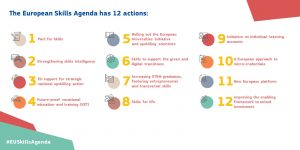
The STEAMonEdu project consortium is especially pleased to see that Action 7 is focused on STEM:
Increasing STEM graduates and fostering entrepreneurial and transversal skill
According to the Communication, to contribute to the required increase of STEM graduates the Commission will:
- raise the attractiveness of STEM studies and careers, with focused actions to attract girls and women, and by encouraging a cross-disciplinary and innovative teaching and learning approach in schools, VET and higher education.
- as part of the European Education Area Communication, introduce activities for teachers, helping address the shortage of STEM teachers in EU countries and regions.
- foster science education in research and innovation actions such as through the development of key competence and assessment framework; dissemination of research results on science education in partnership with the European SchoolNet; and use of socially empowered portals bringing together schools from different European countries, notably those that have experience with the open schooling culture.
- promote an integrated framework and learning continuum inter alia between secondary and higher education systems, education and business in partnership with business professionals, and further pursue open schooling and research-based methods, contests, and citizen science.
The Communication (p.13) states that high level of STEM skills is crucial to foster innovation in cutting-edge ICT areas such as AI or cybersecurity. However, only one in five young people in Europe graduates from STEM tertiary education, less than two million STEM graduates every year. This number needs to increase, which could be achieved by promoting STEM pathways in particular among young women. Currently, only half as many women as men are graduating in STEM fields in the EU, although with huge variations across Member States. There is a need to better explain to young learners, and notably to girls, the opportunities offered by the choice of a STEM pathway.
Our STEAMonEdu project definitely contributes to this action, as our objective is to increase the attractiveness of STE(A)M education, especially among girls. We believe that thanks to the developed methodology and all the training tools, the involved teachers will be better equipped to promote STE(A)M education. If you would like to be part of it, join our STEAMonEdu community!